Saturday, April 7, 2012

WK 2 Reading – The Art of Possibility


Before reading the first four chapters of our book The Art of Possibility By Rosamund Stone Zander and Benjamin Zander, I decided to review Benjamin Zander’s TED performance. One of statements he made that really stood out to me was “One of the characteristics of a leader is to not doubt for a moment, the capacity of the people he’s leading to realize what ever he is dreaming” I was really moved by this statement and the passion he displayed, making this presentation so inspiring to watch.

I think Zander’s enthusiasm really showed through when he connected with the audience by not containing his presentation to just the stage but by getting up close to audience really bringing them into his speech. His ability to play the piano was absolutely beautiful and the way he shared his passion for classical music, not only with the audience but also like myself watching the video, was absolutely amazing. Zander closes the presentation with a simple yet powerful statement from a Holocaust Survivor as a way to bear in mind that it really does matter what we say “I will never say anything that couldn’t stand as the last thing I ever say.” 

The Art of possibility is really a great book, because almost anyone could relate to what this book is speaking to. Its about being able to realize what could be and making things a possibility to live into. 

The book gives us an example of the famous nine-dot puzzle, as a way to show the readers how when first seeing this puzzle you are confined to perceive these dots as a square and when first trying to solve the puzzle many people find themselves struggling. When you actually look at the nine-dot solution you view the nine dots in a completely different way compared to the first set of dots presented. Initially when trying to solve this puzzle you become fixed only on the area that contained the dots. 

The author’s states that our mind creates these fames that confine what we may see as being plausible. The example of the nine-dot puzzle all ties to the underlying point that when you can take those frames created and invent new frames and spaces then you are able to see solutions or opportunities that you may had never noticed.

Each chapter  provides its readers with wonderful examples of how we can shed a new light on making things possible and that every mistake is a learning opportunity and way we can improve. Each chapter provides a section where we can take these ideas and practice them in our everyday lives. 

“ Throw yourself into life as someone who makes a difference, accepting that you may not understand how or why.”

Zander, R. Zander, B. (2002) The Art of Possibility. Transforming professional and personal life 1-65

Saturday, March 31, 2012

Comment on Dana's Blog "Week 1 Reading Entry"


Week 1 Reading Entry


"One video mentioned that copyright isn’t about use, but about permission, which I think is really important to remember.  It doesn’t so much matter how you used something or what your intentions were, but do you have permission to use it? 

I found the Disney clips video, A Fair(y) Use Tale, very interesting.  In talking about fair use, a video mentioned using just a small part, which this video obviously complies with.  This really makes me think about teachers.  I know many teachers show clips and videos all the time.  It makes me wonder: is what a lot of us do on a regular basis actually illegal?

I think there are 2 sides to look at copyright, well maybe 3.  Some people just want movies and music for free.  Some people have fairly good intentions and want to use copyrighted items, maybe for educational purposes and want to see what they can get away with, and hope they don’t get caught.  Another side of that are documentary filmmakers who want to prove a point or preserve history.  To me, this seems like more of an unselfish point of view.

I really like the idea of creative commons.  It’s a way for artists to put their work on the Internet for people to use under the conditions they set.  I thought the video was very nice.  It was nice to see an explanation of creative commons.  We’ve used Flickr Creative Commons in previous classes in this program, but I was never completely clear what it was, exactly."


Dana,

I too also thought the “A Fair(y) Use Tale” was a neat way to show how Fair Use could be used. As I commented on Ana’s Blog, I know I have definitely shown or used copyrighted material without even blinking an eye. I figured since I was using the material for educational purposes then it really didn’t matter, but however after learning more about this topic has made me think twice about what I use. Creative commons was something we used and like you Dana, I really didn’t understand exactly what it was. I think with most of the issues concerning this topic, I was completely surprised with. 

Comment on Ana’s Blog “WK 1 - Reading Entry”


CopyRIGHT or CopyWRONG!


"Copyright is an issue that everyone has a problem with and many do not understand. After reviewing all three copyright issues, they are very complex and confusing for the people, which makes people do the copying without taking in consideration that they are violating the copyright laws.If anyone is interested in reading the copyright law document, here is the link:http://www.copyright.gov/title17/circ92.pdf If people would read the article, there would be more confusion on the subject because of the complexity of it. On a video it states copyright isn’t about use, but about asking permission, that is the key to the whole copyright issue. It basically means use it in whatever you like, but make sure you have consent when you use it. As a teacher, I will have to say that I have probably have broken some copyright laws, but I most likely did this for educational purposes. The school librarian has trained us on some of this copyright laws and making sure we use what is permitted and to give credit when needed."


Ana,

I too as a teacher have broken probably more copyright laws than I would like to admit. I honestly did not know how extensive and confusing these laws really are and since it was for educational purposes I overlooked using copyrighted material. This topic has really opened my eyes to what I use and take from the web and that I need to be aware of what I am using.


Week 1 Leadership Project: Role Model


Leadership is defined according to dictionary.com as the position or function of a leader, a person who guides or directs a group. When someone with leadership abilities exuberate qualities that one can lead with guidance and direction then they are able to judge what is best for the group.


Thinking about this definition, I tried to reflect on people or organizations I see that fulfill some of these qualities that lead for the benefit of its people.

Jackie and I
Someone that I do think really encompasses these qualities is my mentor teacher Jackie Hidalgo, who has shown me what a quality teacher really is. Not only does she go above and beyond her duty as a teacher but also is willing to help any person in need. She offers advice and tips that really make a difference in the classroom. She is able to reach students in such a way that it is truly a work of art. I hope that I can one day be as exuberant of a teacher as she is.


Edutopia is organization that I think puts the public and education at the heart of its message. Edutopia provides the educational community with guidance and methods for use in the classroom while sharing what seems to be working in a field that has gotten away from just that.

Change.org is another organization that empowers anyone to create real change within the community and their country. Change.org allows people to fight for issues they care about and bring about real social change. This website gives a platform to make a difference for the better of people and their environment. 

Friday, March 30, 2012

Week 1: Copyright Issues


Image courtesy of (2008) MikeBlogs.
Some rights reserved.

After viewing and reading the articles provided to us about copyright it is hard to wrap my head around how this term or law has changed and continue to change the way we share, view and create information, art, and media.

I had never particularly paid attention to some of these laws and what they truly meant. This topic has really opened my eyes to a concept that was something I had never known much about as well as Creative Commons, which seems to simplify this ever changing and relatively outdated law.


 Screenshot of “A Shared Culture,”
by Jesse Dylan.
I think Creative Commons was created out of the necessity for all of the confusing copyright infringements that can happen unknowingly. Larry Lessig’s ideas were an essential step forward to help with this massive law. As technology grows and changes, transforms the way people create and view their cultural relevance. So changes in these copyright laws and new Creative Commons is inevitable and will continue to impact how media and art is shared to suit these every changing needs.


Screenshot obtained from centerforsocialmedia.org/fair-use
The notion of Fair Use was intended to provide a safe guard so that copyrighted material can be used or reshown but only in limited and vague circumstances. Which can seem a bit confusing.  So with the notion that, yes this term Fair Use apply and doesn’t apply to situations you may have once thought, brought fourth a Fair Use best code practices guide to help the creator, figure out some of the Fair Use Practices that are applicable to the content the creator is using to recreate his or her own work.


The case with Shepard Fairey seems to fall under these inconspicuous Fair use practices but many people fall on either side of the spectrum with this case especially because of the earlier work Fariey has created as well as not providing credit to the original artist. 


Screenshot of Larry Lessig's TED Conference  
This topic has undoubtedly been an eye opening learning experience to the laws and how I look at material viewed or created.  One point that stood out particularly and can really apply to whole idea of copyright was given by Larry Lessig in his TED conference, describing the term “Democratize” which is roughly described that “anybody with access that can take sounds and images from culture to recreate and say things differently. Theses tools of creativity have become tools of how our kids think, speak, and their relationship to themselves.”


Wk1 Wimba: Course Intro


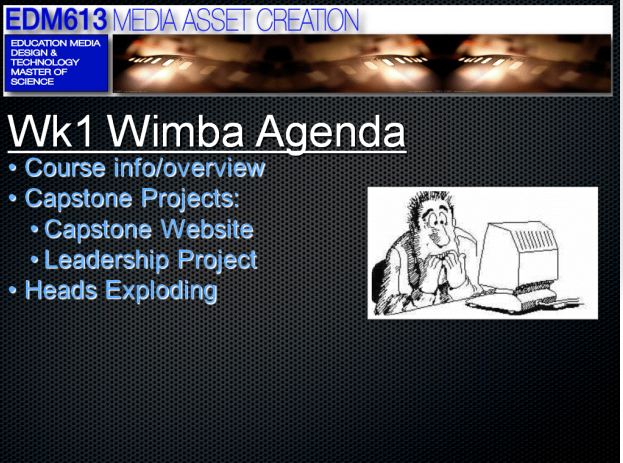
Screenshot of Wk 1 Wimba with Professor Bustillos.

Watching the Wimba archive, I immediately noticed the sound was muffled and a little hard to hear. Even with my headset I was still unable to clearly hear Professor Bustillos. I was actually surprised by this especially because of the mic that was used during Wimba, which looked like a professional radio station mic. Aside from the sound, Wimba did clear up what month 11 is going to look like and was given a run down about what is expected from us within the course.

This course is a little different in the way it is set up and gives us a chance to kind of fine tune our CBR website by adding some of those finishing touches.  Also we were made aware that if we are unable to complete items or projects on time we will not be able to move on to month 12, which is completely understandable. So deadlines must be paid some considerable attention to so that we do not end up in this category.

Another point made in Wimba is how Spring break will be incorporated into the course. From my understanding Week 2 course material will not be due until the 15th of April besides the week 2 discussion posts we should get in by the 6th.  What I like about Spring break showing up in the middle of this course is that it will allot this time so that we can get some things caught up and finish up corrections for CBR submission as well as the Leadership project and abstract that will be due shortly after that. So it is actually coming at a perfect time.

Screenshot of Wk 1 Wimba,  providing CBR guidelines.

In addition to the previous activities mentioned we also need to make corrections given to us by Dr. Bedard so that are CBR website is ready for final submission. These corrections must be done prior to April 16th or else it will affect our standing with moving forward to month 12.


Week one Wimba was pretty informative and covered a lot of questions about some of the fundamental dates and activities we will be encountering throughout the month.